Tuesday, July 22, 2008

Samantha Crain


My friend and fellow filmmaker Sterlin Harjo just put together this great little video introducing Samantha Crain. She's an amazing singer-songwriter from Oklahoma, and I'm sure you'll be seeing more of her very soon.


CHECK IT OUT!

Tuesday, July 15, 2008

So, so sorry

I'm in the midst of some very tight deadlines, so you will have to go without a post for a few days. I've been shooting and cutting a highlight reel for LMU's Summer Creative Workshop. The kids are amazing, but the hours are dreadful and unforgiving. On top of which, I've been doing some heavy polishing on my baby: the feature script. So, please be patient and keep looking out for some new posts.

Sunday, July 13, 2008

WAAALLLLLLLLLL-EEEEEEE!!!!!!!!!


On the off chance you've been living in a cave for the past few weeks (as can happen when you're on location doing 6-day weeks), go see this amazing film. I've already seen it twice. To all you critics hating on this movie: I'm sure it is tough to look in the mirror when you don't like what you see.

Thursday, July 10, 2008

Death by Chainsaw


Today’s post is predominantly for the Production Office, but can be used by all crew members for their use of paper at home. Here are some basic tips:

1. Provide recycle bins
Make sure a bin is clearly indicated that it is for recycled paper only, and place it right next to the trash cans. If you’re buying paper in bulk, you can often use the boxes that they come in as recycle bins throughout your office or for the production office that is on the move (such as in the trailer or at base camp).

2. Use recycled paper
Not only is it important to have recycle bins for discarded paper, but also to use recycled paper. Use of recycled paper is a vital part of the cycle. There’s no point in recycling paper if we don’t use its byproduct.

3. Print only when necessary
Before you print ask yourself, “Do I really need to print this?”

If it is a file that can stay digital, do so. One of the great things about technology is that the files we use can stay in the digital realm. My cell phone has been a great tool. I use it to make a note of addresses that I either type into my notes application, or, if I’m in a hurry, I just take a picture of it on my camera phone. Then, I type the address into my GPS system. I also save flight information in my phone. So, instead of printing out 3 pages of an itinerary, I either save the Flight confirmation number as a note, or just use my email to pull up my confirmation information. Then, I type in that info when I check in at the airport.

Another way to go paperless is the use of the IPhone. As expensive as it is, I know there are a lot of you out there that have them. Instead of printing out your call sheets or directions, just download it to your phone.

When possible, send out your scripts via email. And when someone sends you a script to read that is still in development, read it on your computer, and type out notes in word. If you have Final Draft, you can add script notes directly to the file. It will insert a small window next to the text that the reader can double-click on to see your notes.

4. Print efficiently
Gone are the days when printing on both sides is considered informal. When you have to provide a hard copy of your script to someone, print on both sides. If you’re providing multiple pages of any file, it should be a general rule of thumb.

Check and recheck. How many times have you printed something out only to realize that you made a typo? Make sure you thoroughly read your files before printing.

Use print preview. There are so many internet pages that I print out where that last page contains an advertisement or a single line of text. Check it out in Preview first, then print out only the necessary pages.

On several sets I’ve worked on, Sides were shrunk to half their size and printed on half of an 8x11 sheet of paper. Not only is it more efficient, but it’s easier for Keys and Actors to carry the scenes of the day in their back pocket.

5. Know when to say when
If you’re a bit lower on the totem pole, ask yourself if you really need the sides that get passed around on set. PAs or 2nd ADs, keep track of who says “yes” and who says “no.” So, for the following days, you know exactly how many sides to photocopy, and you’re not printing out any excess.

6. For the OCDs
I separate my paper into 3 sections: Everyday paper, Specialty Paper, and Scratch Paper. Next to the printer, use trays that are clearly labeled.

Everyday paper is of course your low-grade RECYCLED paper that you can use for things like call sheets, sides, shot lists, etc. Specialty Paper usually will have stock paper or photo paper. Anything that is a heavier stock than your Everyday Paper.
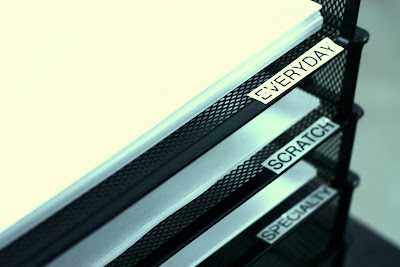
Scratch Paper will include paper that’s already been printed on. As a cinematographer, I get sent so many scripts that never make it to production. And they end up collecting dust on my desk waiting to be realized. Whether it be old scripts, call sheets or extra copies, I set those aside instead of throwing them in the recycle bin. I use them to print things like Maps or directions for PAs, personal notes that I need to take with me on the go, or film festival itineraries. For the most part, I use it for information that I know only I will see. It gives paper a second life, if you will. It’s where you can make up a bit for throwing down the extra cash for recycled paper.

Overall, it’s about making it easy for everyone to recycle and conserve. The more organized your office space is, the better.

Monday, July 7, 2008

Ishmael


I just finished reading Daniel Quinn's Ishmael. If you haven't already read it, it is a definite must. The cautionary themes this book addresses are so relevant to the issue of our rapidly deteriorating ecosystem. Its philosophies only reinforce the need to simplify our lives and only take from earth what is necessary. It's an extremely fast read, and I highly recommend it.

Sunday, July 6, 2008

Synthetic Polymerized Receptacle of H20 Syndrome


Does this photograph look familiar? Are you often left with several half-empty, unclaimed water bottles at the end of a shoot day? Are some of these water bottles even nearly full? You and your colleagues could be suffering from SPRHS, or Synthetic Polymerized Receptacle of H20 Syndrome. This condition is more commonly known as the Bottled Water Scam.

The waste of bottled water on set is probably the issue that crawls under my skin the most. Recently, I started bringing a reusable bottle to set. I simply filled it with water from my tap the night before, and stuck it in the fridge for ice cold water in the morning. In case you missed it, yes, I did say it. From my T-A-P. TAP! Gasp in horror. Go right ahead. There is a fabulous article on treehugger.com detailing how water bottle companies have pulled the wool over our eyes for years. That Dasani, a Coca-Cola company, even puts salt in their water to make it taste better. Well, I have news for you. Perfectly clean, sodium-free water actually gets delivered directly to your kitchen at almost no cost to you. And for all you OCD’s out there (me included) you can easily buy a Brita or PUR filter that goes directly onto your faucet. The great thing about bringing your own water bottle is that you're always able to keep track of it throughout the day.

Bitchy Production Designer: “Who left their green water bottle with the pink flowers on the HOT SET?!?!?!

Awesome Clapper Loader: OOOOH. OOOH. That’s mine, thank you.”

As the Producer, provide your eco-conscious crew members with a refillable station at the Craft Services table like this Coleman cooler.


Make sure your PAs fill it with water AND ice, to ensure ice cold water on set.

One thing I suggest, specifically for feature-length projects, is to purchase canteens or reusable bottles for your crew members instead of buying them the requisite souvenir T-Shirts. By passing them out at the beginning of production, you are sending your crew members the message that you intend to be a Green set. Klean Kanteen provides canteens with your personalized logo on them. The beauty of a canteen is that it keeps cooler longer, and no nasty plastic toxins seeping into your water.


My Alma Mater Loyola Marymount University went completely Green by providing their students with canteens and installing more water fountains on campus. If a campus of 8,972 can change their water-consumption lifestyle, I’m sure we could handle a crew of 20 to 50.

That being said, I know there needs to be at least some source of water for the degenerates or day players. So, at the very least, keep a few water bottles in that cooler and, most importantly, a Sharpie tied to the handle as a friendly reminder to keep track of their bottle.

Wednesday, July 2, 2008

Delta's Commitment


I decided to post today's Daily Photo. On my flight to the Tel Aviv International Student Film Festival, Delta provided these wonderful amenity kits "made Earth-friendly through the use of natural, biodegradable and recycled materials." This toothbrush was made with biodegradable soy products. The bag was of course made with recycled paper and printed with biodegradable inks. For more info, check out their site delta.com/globalgood.